
If your Carolina Forest community has a pond near the entrance, along a common area, or fronting a golf fairway, you already know what a well-maintained water feature with a running fountain communicates to residents and visitors. It signals that the community is managed. It adds visual interest and a sense of amenity that still photographs well, shows well, and holds up in day-to-day experience.
What most HOA boards and community managers don't fully appreciate is that the fountain doing all of that visual work is also one of the most practical water quality tools available for managing the pond it sits in, and in Carolina Forest's climate, that functional role is just as important as the aesthetic one.
This post explains how pond aeration systems work, why they matter specifically for coastal South Carolina's warm, nutrient-loaded stormwater ponds, and how to think about aeration as an investment rather than a line-item cost.
Why Aeration Matters in a Coastal South Carolina Pond
To understand what a fountain or aerator actually does for a pond, it helps to understand what happens to a pond that doesn't have one.
Stormwater ponds are, by design, slow-moving bodies of water. They are built to hold runoff, not pass it through quickly. In warm weather, still water stratifies, it separates into distinct layers based on temperature and dissolved oxygen content, with warmer, oxygen-depleted water settling near the bottom and cooler, slightly more oxygenated water at the surface. In the coastal South Carolina heat, that stratification becomes pronounced quickly.
Stratified, oxygen-depleted water at the pond bottom creates anaerobic conditions, an environment without adequate oxygen where organic matter decomposes differently than it would in a well-oxygenated system. The byproducts of that anaerobic decomposition include hydrogen sulfide (the rotten egg odor that generates resident complaints) and the release of phosphorus from bottom sediments back into the water column this is the same phosphorus that drives algae growth at the surface.
At the same time, the warm, nutrient-rich surface layer becomes an ideal environment for algae and cyanobacteria. Algae spores in stratified water concentrate near the surface where they have access to sunlight and nutrients, accelerating bloom development. Without something actively disrupting that stratification and introducing oxygen throughout the water column, the conditions that produce algae, odors, and water quality problems are essentially self-reinforcing.
Aeration interrupts that cycle. By moving water, introducing dissolved oxygen, and breaking up thermal stratification, a properly selected and maintained aeration system creates conditions that are less hospitable to problem algae and more supportive of the natural biological processes that keep water quality in balance.
Fountains vs. Submersed Aeration: Understanding the Difference
Not all aeration systems are the same, and the right choice for a Carolina Forest community pond depends on the specific depth, size, and goals of the water body in question. Understanding the distinction between the two primary system types is important for boards and community managers making investment decisions.
Floating Fountains
A floating fountain is an electric motor attached to a float that draws water from near the surface and propels it into the air in a spray pattern. As the water falls back to the pond surface, it introduces turbulence that allows subsurface gases, including the hydrogen sulfide and carbon dioxide produced by anaerobic decomposition, to escape, while facilitating the transfer of atmospheric oxygen into the surface layer of the water.
Floating fountains are most effective in shallower ponds, typically those with an average depth of six feet or less. For the majority of stormwater ponds in Carolina Forest communities, which are engineered to relatively shallow depths to maximize surface area for runoff capture, a properly sized floating fountain delivers meaningful aeration benefit alongside the visible aesthetic value.
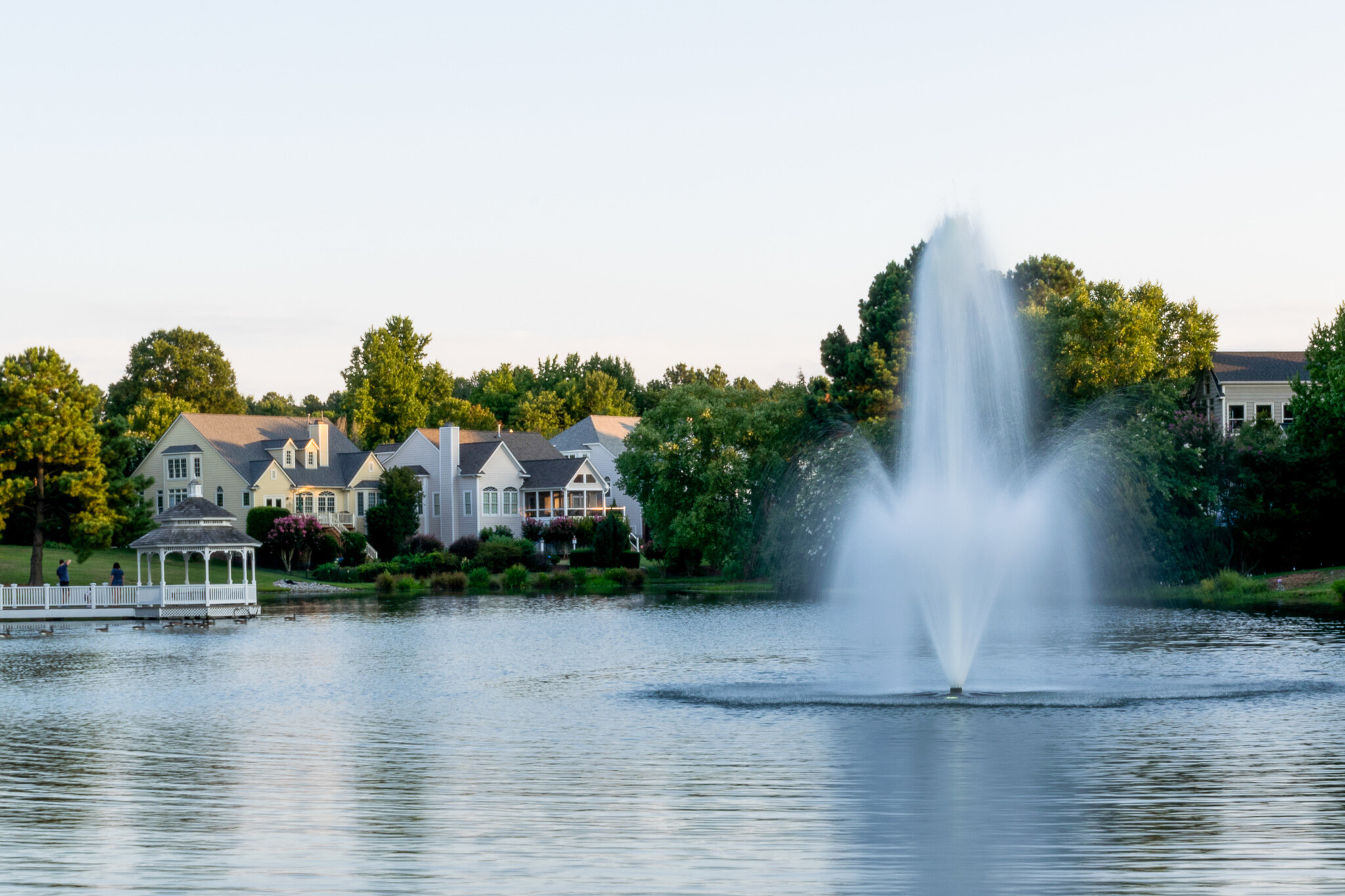
Fountains are also the aeration option with the widest range of spray pattern choices, from simple single-spray configurations to multi-tiered display patterns that are a genuine landscape feature in high-visibility settings like community entrances, golf course water hazards, and lake-front common areas. In a market where pond and lake views are referenced in real estate listings as a selling point, as they are consistently throughout Carolina Forest, Waterford Plantation, Berkshire Forest, and Plantation Lakes, a well-chosen fountain pattern in a well-maintained pond is not just infrastructure. It's part of the community identity.
Submersed Diffused Aeration
Submersed or diffused aeration systems work differently from fountains. A compressor located onshore pumps air through subsurface tubing to diffusers positioned at the pond bottom. Those diffusers release fine air bubbles that rise through the water column, carrying oxygen-depleted bottom water toward the surface as they go. The continuous vertical mixing that results increases dissolved oxygen concentration throughout the entire water column, not just at the surface.
Submersed aeration systems are generally the better choice for deeper ponds, those with average depths above six feet, where a surface fountain cannot effectively reach the oxygen-depleted bottom layers. They are less visually prominent than fountains, but they provide more comprehensive oxygenation in water bodies where depth creates the stratification problems that drive water quality deterioration.
For communities with deeper ponds or lakes. Plantation Lakes with its 170-acre lake system, or Berkshire Forest's 32-acre centerpiece lake, for example, submersed aeration may be the more technically appropriate choice, potentially in combination with a fountain that handles the visible, surface-level water quality and aesthetic functions.
Combining Both Systems
In some situations, the most effective approach is both. A fountain provides surface aeration, visible water movement, and aesthetic value. A submersed diffused system handles the deeper oxygen dynamics the fountain cannot reach. For larger, high-visibility community lakes where water quality and curb appeal are both priorities, that combination is not uncommon. And for communities managing a network of ponds with different depths, the right system type will vary by pond
What Aeration Actually Does for Water Quality
Boards evaluating an aeration investment want to understand the specific, practical benefits beyond the general principle that "more oxygen is better." Here is what a properly maintained aeration system delivers in a Carolina Forest stormwater pond:
Algae Pressure Reduction. Dissolved oxygen, when present throughout the water column, helps convert excess phosphorus and nitrogen into forms that do not sustain algae growth. Aeration also circulates the water in ways that disrupt the surface concentration of algae spores, reducing their access to the consistent sunlight exposure they need for rapid bloom development. Aeration is not an algae treatment, it does not eliminate an established bloom, but it is one of the most effective preventive tools available for reducing the frequency and severity of bloom events between treatment cycles.
Odor Elimination. The hydrogen sulfide odor that characterizes a neglected stormwater pond comes primarily from anaerobic decomposition at the pond bottom. Introducing dissolved oxygen to the bottom of the water column through aeration shifts that environment from anaerobic to aerobic, fundamentally changing the decomposition chemistry and eliminating the conditions that produce the odor. For communities where pond odors have been a recurring resident complaint, adding or upgrading an aeration system is often the single most effective intervention available.
Organic Matter Decomposition. In an oxygenated water column, beneficial bacteria are able to break down the organic matter, such as leaf litter, grass clippings, dead algae, that would otherwise accumulate as nutrient-rich sediment at the pond bottom. Functional aeration slows the rate of sediment accumulation, which directly affects the long-term cost of the pond's maintenance program. A pond with a well-maintained aerator will accumulate sediment more slowly than an identical pond without one, extending the interval before dredging becomes necessary.
Mosquito Deterrence. Moving water is a less hospitable environment for mosquito breeding than still, stagnant water. For communities along coastal South Carolina where mosquito pressure is a quality-of-life concern from spring through fall, aeration contributes meaningfully to the overall management program.
Reduced Treatment Frequency. Water quality in a well-aerated pond responds better to algae and vegetation treatments and maintains improved conditions for longer between treatment events. For HOA boards managing pond maintenance budgets, aeration can reduce the total number of treatment interventions required over the course of a season. This is an operational cost offset that partially recaptures the investment over time.
Aeration Is Only as Effective as Its Maintenance Program
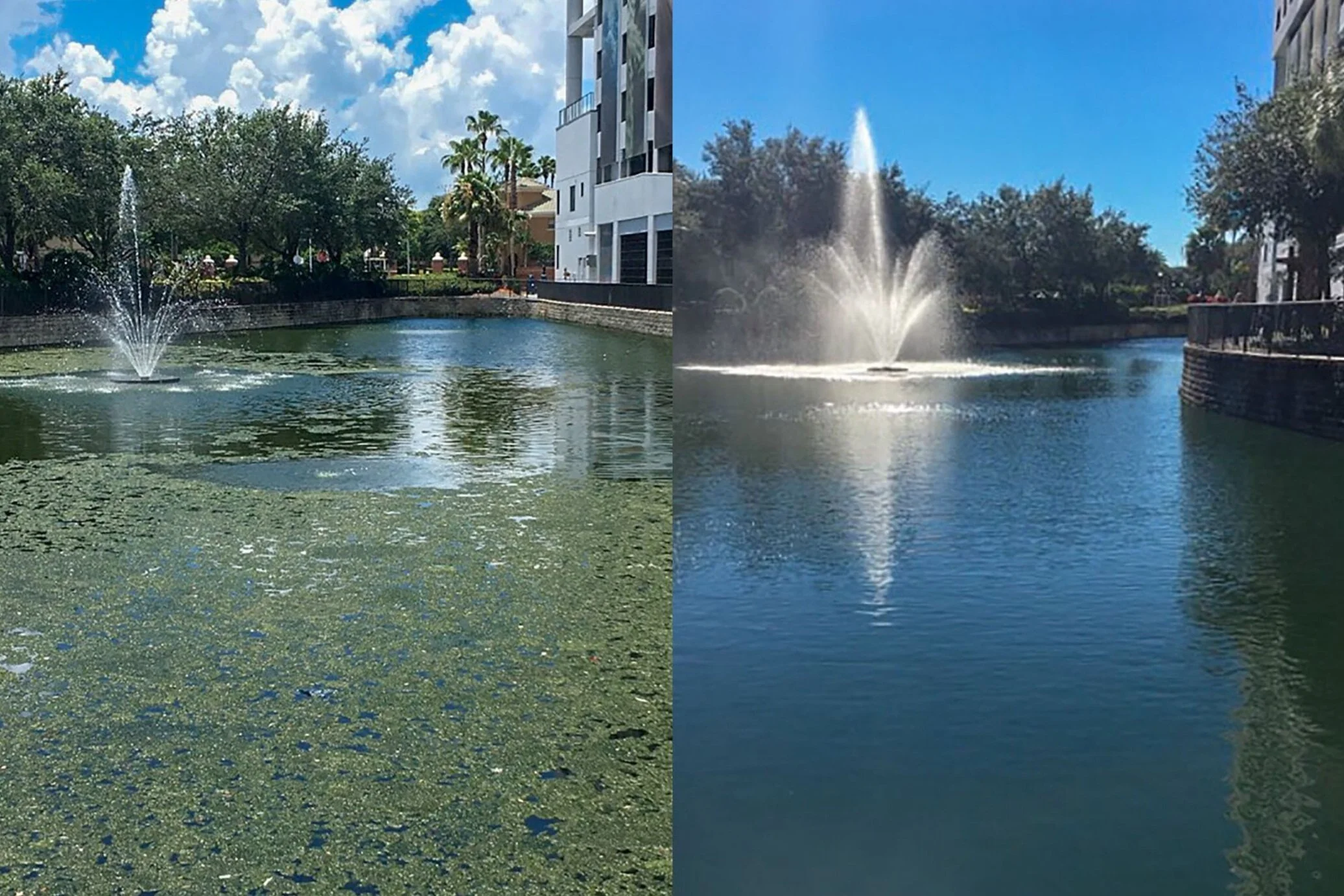
Before and after: A fountain alone wasn't enough to keep this high-traffic pond clear. Persistent trash kept clogging the fountain and fueling recurring algae blooms. Team Dragonfly added two aerators and beneficial bacteria to restore healthy circulation, then stepped up maintenance visits to clear debris and keep the equipment running—proof that aeration works best when it's backed by a consistent maintenance program.
This is the point that separates communities that see consistent benefit from their aeration systems from those that don't.
A fountain or aerator that is installed and then left without a maintenance program delivers declining performance over time and eventually delivers none at all. Motors wear. Floats develop problems. Spray patterns degrade as nozzles clog or corrode. Diffuser lines accumulate biological growth that restricts airflow. In a community pond setting, these systems operate year-round in a challenging environment that includes warm water, UV exposure, biological activity. They require regular inspection, cleaning, seasonal service, and prompt attention when problems develop.
For HOA boards and community managers, this means that aeration investment decisions should include the maintenance program, not just the equipment. A fountain that runs properly for three seasons and then degrades to a weak, irregular spray for the next two is not providing the water quality benefit the community paid for.
Dragonfly Pond Works maintains aeration and fountain systems as part of comprehensive pond management programs, including routine inspections, seasonal service, cleaning, and repair response. For communities considering a new fountain or aerator installation, we assess each pond and recommend the appropriate system type, size, and configuration before any equipment decision is made.
The Investment Case for Carolina Forest HOAs
For boards evaluating whether a fountain or aeration system is a justifiable expenditure, the question is worth framing accurately.
An aeration system is not a luxury feature. In Carolina Forest's climate, with its warm water temperatures, extended growing season, and nutrient-loaded stormwater inputs, it is one of the most cost-effective tools available for managing the water quality conditions that generate resident complaints, drive treatment costs, and accelerate the rate of sediment accumulation that eventually requires dredging.
The visible benefit, a functioning fountain in an entrance pond or a community lake, also has real real estate and community identity value. Carolina Forest buyers consistently cite pond and lake views as desirable features, and real estate listings throughout communities like Waterford Plantation, Berkshire Forest, and Plantation Lakes reference water views and fountain features as selling points. A well-maintained fountain in a clear, clean pond is a community asset. A stagnant, algae-covered pond in the same location is a liability.
The communities that manage both well, water quality and curb appeal, do so because they have recognized that the two are connected, and that the systems keeping the water healthy are also the ones making it look good.
Next Steps
If your Carolina Forest community's ponds don't have an aeration system, or if existing systems haven't been properly maintained, a site assessment is the right starting point.
Dragonfly Pond Works provides free pond assessments for Carolina Forest HOA communities. We evaluate each pond, assess current water quality conditions and aeration needs, and provide a clear recommendation, including system type, sizing, and maintenance program, with no obligation.
Schedule Your Free Carolina Forest Pond Assessment →
Or contact us directly: Phone: 910-833-9764 Email: Info@dragonflypondworks.com
Dragonfly Pond Works provides full-service HOA pond maintenance, fountain and aeration installation and maintenance, stormwater BMP management, and pond repair and restoration services in Carolina Forest, Myrtle Beach, and throughout coastal South Carolina. We work with HOA boards, community association managers, property management firms, golf course communities, and municipalities.