
Streambank Stabilization
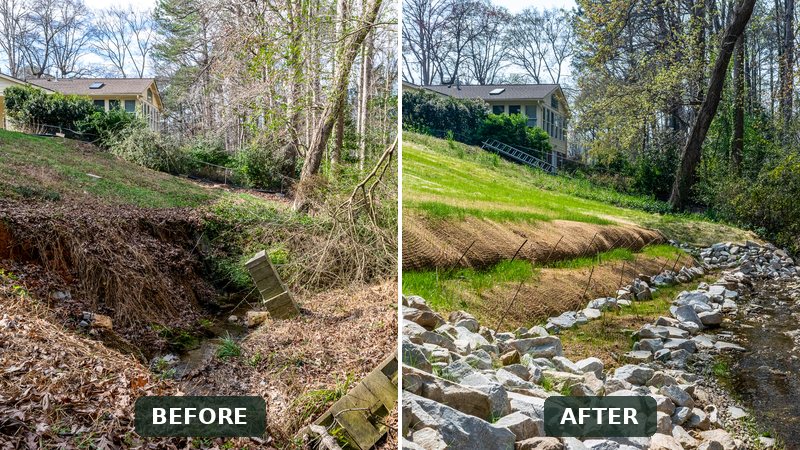
Moving water hits an unprotected stream bank with enough force to undercut it, sending soil downstream into ponds and channels. Our team grades the bank, sets stone or fiber rolls, and installs native plants that are built to handle the flow and hold the ground.
Branch Locations:
Raleigh-Durham, Charlotte, Winston-Salem / Greensboro, Wilmington, Myrtle Beach, Charleston, Greenville-Spartanburg, Atlanta, Savannah, Orlando, Tampa, Virginia Beach, Fairfax, Montgomery County, Lewes, Chicago, Houston, Dallas-Fort Worth, San Marcos Corridor, Nashville
Have a multi-site footprint? Learn how we can work with you
Service DescriptioN
About Our Streambank Stabilization Service
Streambank stabilization is the work of protecting the bank of a stream, creek, or river from the erosion that moving water causes.
Flowing water carries energy. When a channel is straightened, narrowed, or stripped of vegetation, that energy hits the stream bank instead of spreading across the bed and floodplain. The bank undercuts, slumps, and sends soil downstream, where it fills ponds, lakes, and culverts.
Dragonfly Pond Works repairs these banks with methods built for moving water. That can include grading the bank back to a stable slope, placing stone or wrapped soil lifts where the current hits hardest, and planting the edge so roots hold the soil once they establish. Coir logs and similar fiber rolls protect new plantings while they take hold. The same approach applies to riverbank stabilization on larger channels.
We prioritize the health, function, aesthetic appeal, and value of the waterway and the land beside it. A stable bank protects property and keeps soil out of the water downstream.
Key Benefits of Streambank Stabilization
Protects Land and Structures
Stopping the bank from moving protects yards, paths, fences, and buildings near the water.
Less Sediment Moving Downstream
Soil that stays on the stream bank does not fill the ponds and culverts below it.
Repairs Built for Moving Water
Each streambank stabilization repair is designed for the speed and force of the flow, not borrowed from still water work.
Planting That Takes Over the Work
Native roots bind the soil over time, so the bank gets stronger as it matures.
A Bank That Looks Like It Belongs
Planted repairs blend into the setting, which residents and visitors appreciate.
Clear Records for Boards and Agencies
A detailed photo report documents the work for HOA boards, municipalities, and community members.
From The Field
Service Photos


How It Works
Review the Reach
We walk the bank and note where it is failing, how the channel bends, and what the flow does during high water.
Find the Cause
We look at slope, soil, vegetation loss, and upstream changes that may be pushing more energy at the bank.
Design the Repair
We choose a combination of grading, stone, wrapped soil lifts, fiber rolls, and planting to fit the site.
Build in Sequence
Our crews reshape the bank and install the materials in an order that protects the repair as it goes in.
Plant, Report, and Follow Up
We plant the edge, protect new growth until it establishes, and document the streambank stabilization with a detailed photo report.
Why Streambank Stabilization is Important
Bank erosion on a stream or river rarely stays contained. Once a bank starts losing soil, the channel widens, the current shifts, and the next section takes more of the load. The soil that leaves ends up downstream, filling ponds, lakes, and pipes.
Streambank stabilization stops that chain. It protects the land, the water, and the properties that depend on both. We prioritize repairs that work with the flow instead of fighting it, because those hold up better through high water.
Streambank Stabilization FAQs
Answers to our most common questions about this service. If you have a different question not answered here, get in touch.
Signs include steep or undercut banks, exposed roots, leaning trees, fresh soil in the water after storms, and fences or paths creeping toward the edge.
Repairs are designed for the high flows the channel sees. Stone at the base and established roots give the bank strength during storms.
Most stream work needs permits. We review the requirements during planning and coordinate the paperwork as part of the project.
Often, yes. Gentle slopes with moderate flow can be stabilized mostly with plants and fiber rolls. Sharp bends and fast water usually need some stone at the base.
The methods are the same. River banks are usually larger and carry more flow, so repairs are scaled up to match.
Yes. We work with HOAs, municipalities, facility managers, and private landowners along streams and rivers.